Hugh Garner
/Hugh Garner was an author, editor, journalist, teacher, and reviewer whose focus was on working-class Ontario.
He was born on February 22, 1913, in Batley, Yorkshire, England. He came to Canada in 1919 with his parents, and was raised in Toronto where he attended Danforth Technical High School.
“Garner's poor, urban and Protestant background was a rare one for a Canadian writer and pervades his work. His focus is working-class Ontario and his preferred genre, the realistic novel. Frequently, his theme is the victimization of the worker…” The Canadian Encyclopedia.
Earle Toppings, Ryerson Press asks, “Is it true you said you didn’t become a writer to grow rich, famous and socially acceptable?” Laughingly he says, “Yes, not to become rich and I don’t think I’ll ever be socially acceptable.”
Garner wrote 100 short stories, 17 books, hundreds of articles and radio and TV scripts. “This productivity was a result both of Garner’s provocatively anti-intellectual aesthetic credo leading him to state that “the first duty of a writer is to entertain” and of the necessity - emphasized by Garner himself - to earn a living as a writer.” De Gruyter Brill, Stefan Ferguson.
“During the 1950s the burgeoning television and radio market, began to affect sales of magazines in Canada. Garner was able to adapt his short stories into radio and television scripts, and developed a system to maximize the income of a single story: he would first sell his work to the CBC in script format, would then submit a short story version to magazines, little magazines, quarterlies, and journals, and finally, would group the stories and try to issue them as a collection.
“…he was an unabashedly vocal self-promoter of his own writing. As an outspoken social critic and self-proclaimed “one man trade union,” Garner was not afraid to argue with his agents, publishers, and editors in order to control the content of his writing, ensure that his books were properly displayed in retail outlets, and to squeeze as much income as he could from his published works.” Earle Toppings interview, The "One Man Trade Union" of Publishing, Marc Fortin, Queen's University.
His best-known novel, Cabbagetown, is set in a poor working-class neighbourhood in the downtown east end of Toronto. The inhabitants were Scottish and English immigrants, many of whom were first generation and all working class and poor. Garner described it as, “The largest Anglo-Saxon slum in North America.”
"As a social document, Cabbagetown is as important and revealing as either The Tin Flute or The Grapes of Wrath. Stern realism has also projected upon the pages of a whole gallery of types, lifelike and convincing. Garner is well fitted to hold the mirror up to human nature." Globe and Mail.
In the final chapter of Cabbagetown, the central character, Ken Tilling, leaves Toronto in 1936 to fight in Spain. He joins workers from all over the world who had organized themselves into International Brigades to fight alongside the Republican forces. The Republican government was elected, but General Francisco Franco led the Nationalist forces in a coup against the government. As the first fascist leader of that era, Franco received military support from Hitler and Mussolini and defeated the Republican forces.
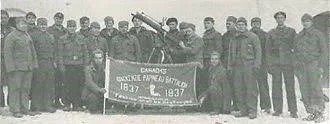
Speaking to Earle Toppings Garner says, “Yes, I fought in the Spanish Civil War and it was one of the nice things I did. It was one of the decent things I did. I fought with a bunch of nice guys. Most of them were communists and all sorts of groups of the left. There’s never been International Brigades since. All voluntary. I was dedicated to the cause of the people of Spain.”
“The dawn is a widened earth – a populated earth. The dawn is not only the beginning of the day, but the ending of the day,” the final two lines of Cabbagetown as Tilling is in Spain.
Hugh Garner’s Best Stories received the Governor General’s Literary Award for English-language fiction in 1963.
“The collection consists of twenty-four stories composed between the late 1930s and the early 1960s and reflects the immense flux of the mid-century, from the Great Depression to the Spanish Civil War, World War II, the Civil Rights movement, and second-wave feminism. Garner takes on issues ranging from anglophone–francophone conflict in Canada to racism in the American South, from the disenfranchisement of First Nations people to the mistreatment of the mentally disabled.” University of Ottawa Press.
Garner’s books were widely used in schools in Ontario and other provinces. In 2023 the Minister of Education ordered all books written before 2008 taken off the shelves. “If the shelves look emptier right now, it’s because we have to remove all books [published] prior to 2008.” Erindale Secondary School, Mississauga, New York Post.
The Hugh Garner Housing Co-operative on Ontario Street is named after him and includes a. plaque honouring the writer.
He died on June 30, 1979, in Toronto.
“I’d like to be remembered as an honest man who brought ordinary people to light for the reading public.”
Sources
De Gruyter Brill, Stefan Ferguson
Queen's University, Marc Fortin
The Canadian Encyclopedia
Wikipedia
Cabbagetown People
Globe and Mail
University of Ottawa Press
New York Post